
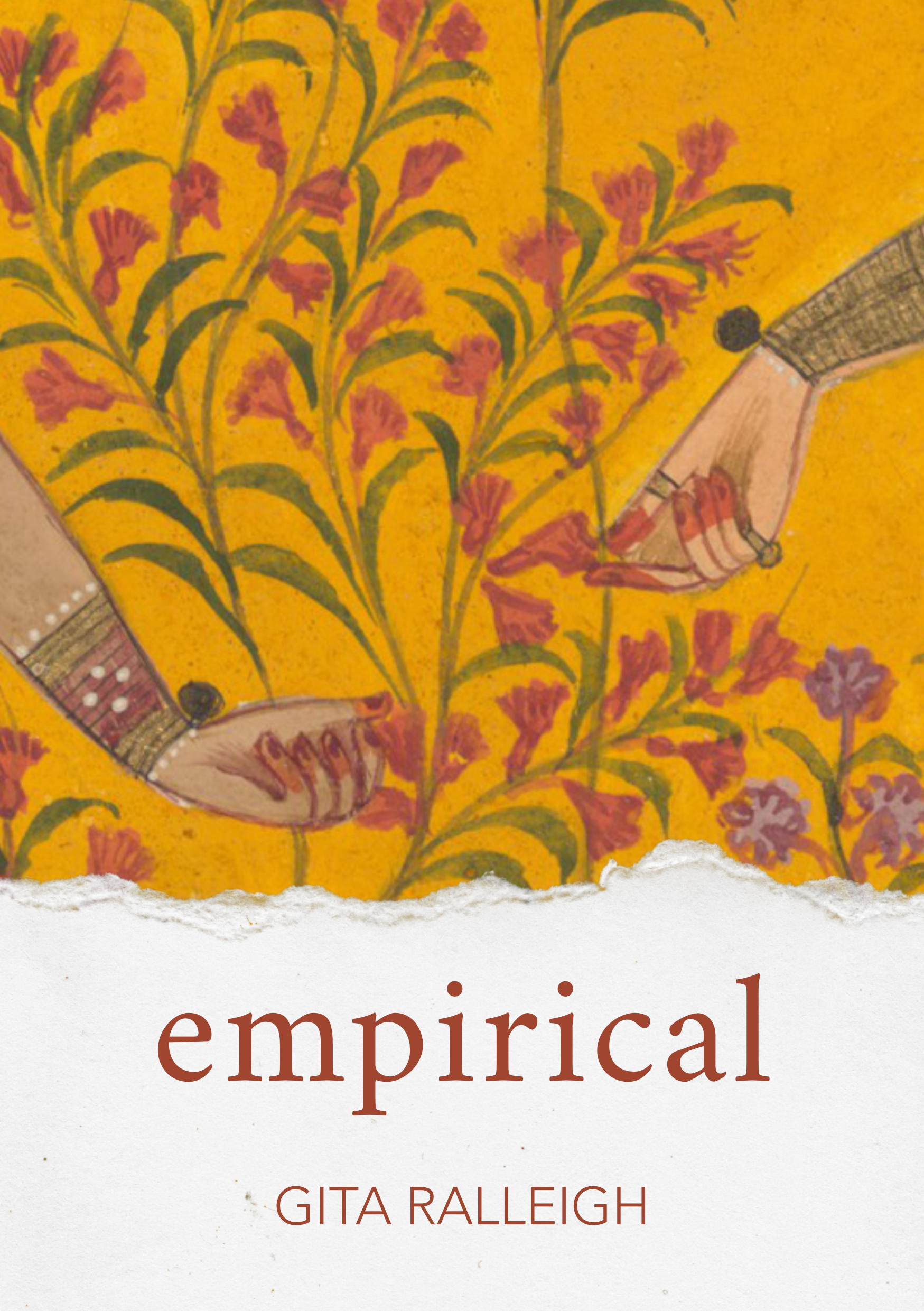
Empirical
Gita Ralleigh
The Braag
As someone who is at least three years into trying to write the same poem in a specific form and still hasn’t managed to complete it, I am always in awe of those whose writing in form appears effortless - even if, in truth, the process is far from it. I am even more amazed by poets who can take those forms as an influence beyond simply following their rules, creating new and further possibilities whilst keeping the intention of the original.
In Empirical, Gita Ralleigh does just this. From the opening poem, Ghazal: Immigrant, she harnesses the lyrical quality of the traditional ghazal form whilst bringing a contemporary sensibility to it. She refers to herself as an ‘awkward dork, clunky animal’, before increasing the tension as she enters ‘the police state under curfew’. These unexpected references stretch the gentler dimensions of the form, and displace it.
The ghazal, both as a form and a style, makes other appearances throughout the collection; its lyrical, sonic couplets echoing through other poems. Gita is unafraid to lean into sounds - both those that work beautifully together in her use of rhyme and those that deliberately jar, making the reader pause and reconsider what they are hearing.
Gita uses rich language to evoke the worlds she describes, such as ‘particles of matter / blown weightless / in a tunnelling wind’ in Manhattan (2001), and ‘Dust transfigures to whirligig cloud, fragmented glitter’ in Domestic Fantasy. These expansive images are balanced by simple, beautiful statements that make their point firmly and ground the poems. The opening of Day of the Dead, for example, gives us the quietly affecting observation: ‘Autumn feels personal this time.’
What is also striking about the collection is the way the poems evoke not only places across the world, but also their different histories, with a strong sense of time and an awareness of the past. Father Shows Us a Tiger (1977) is one such example of storytelling that evokes a specific history and geography. This is a book that covers a lot of ground, but its variety feels like part of its purpose.
Returning to form, as this collection often does, Gita is as playful with the space and appearance of the poems on the page as she is with the words within them. From the gentle spacing and separation of Bird Organ to the deliberate carving out of space in moondaughter i, the visual choices feel as considered as the language itself. Again, this adds to the breadth of the collection, demonstrating a control that allows the poems to move between different shapes, sounds and subjects.
Empirical is an unexpected and richly textured journey, exploring what it means to belong to a number of different ideas, histories and places in a world that is itself full of contradictions and competing identities. There is something reassuring about seeing a poet treat form not as a set of rules to be mastered, but as something to play with, stretch and occasionally push into unfamiliar territory. I may not have found my way to the end of my own poem yet, but Empirical is a reminder that sometimes the most interesting thing a poem can do is find a way of making rules its own.
Gita was kind enough to answer some questions about her pamphlet...
What influenced you to start writing poetry?
I was firmly a prose writer but a decade ago, I had trouble focusing on fiction, so turned to poetry. I hadn’t read much contemporary work but discovered Claudia Rankine’s ‘Citizen’, then read everything I could get my hands on, and began writing poetry myself.
How did the idea for this pamphlet come about?
The pamphlet came together more slowly than my first two. The images seemed quite disparate at first - ranging from personal experience to public histories. Mia You’s poem ‘Sparkling Heart Empire, which I used as an epigraph, really showed me how the two are linked - something which I knew, but had trouble articulating.
You can see a clear influence of the ghazal throughout the book - what draws you to this form?
Thank you for asking about the ghazal, a form I love and one which is often sung in South Asian culture - like the pop song is a form of lyric poetry. Attending a workshop with Mona Arshi and hearing her read her beautiful ghazals really inspired me to attempt my own.
What’s a line or idea from the collection that you hope readers don’t miss?
I’m not sure I can pick out a single line because I think different poems speak to different readers, but I’m most proud of the poem ‘Ghazal: Immigrant’ which I hope reclaims the word. It was also quite difficult for me to write because the immigrant experience is not seen as the stuff of poetry - or not the poetry I grew up with.
What do you do when a poem won’t behave?
If I am struggling with a poem, the best tip I think, is to leave it alone for weeks, months even years and come back to it. I have a folder full of poems waiting to find their final form!