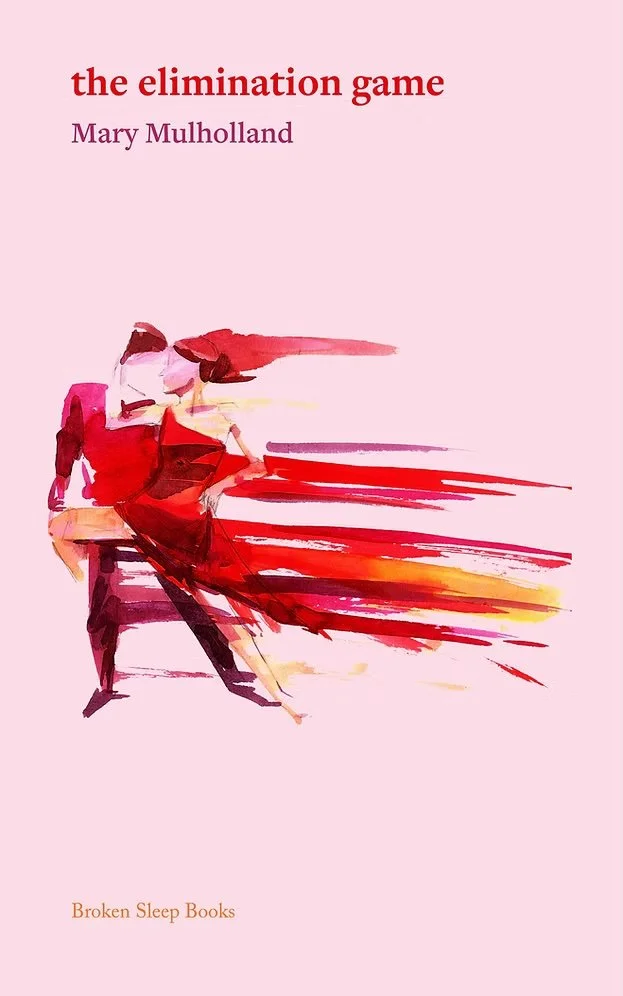
the elimination game
Mary Mulholland
Broken Sleep
As poets, we all have our preoccupations. Sometimes they’re obvious — you can spot the obsession in every poem. This is not a bad thing - sometimes, this centres our work and brings it together in new meanings, and sometimes we have to consider editing a word out because we realise we’ve used it in the last ten poems we’ve written.
the elimination game is a collection tied by feeling and theme, and the imagery in which the poet’s world is conveyed, is so broad and far ranging, that it really does feel like a whole world is what we are exploring. We move easily between workmen and the art of ancient Egypt, to Agatha Christie and the colour of clouds. As this collection is about the lengths of life and its experiences, this approach makes it feel like a photo album - snapshots and nostalgic pauses, each held by tender writing and a gentle significance.
Whilst the inspiration for each poem is broad, Mary’s writing is accomplished and precise. Whilst there is that great range of images, her use of them is deliberate and her description is chosen to convey huge meaning in few words ‘and her chin - think Lowry’ from Beard, ‘your eyes shut fast like a puppy’ from Role Change. This economy keeps the poems moving, whilst allowing the reader a clear and quickly oriented glimpse into the moments each describes.
As well as the words themselves, breaks between them are thoughtful and used in a range of ways across the poems. They make the reader pause to take in an interesting image (‘crows know the mystery of life, they don’t sing / lullabies’ from Pieta), occasionally add humour (‘it’s the age people concentrate on close bonds / with dentists and doctors’ from Why I’m Signing Up for Psycho-Tango) and they turn the poems around (‘If we try our hands at poetry or art, that’s best / left to the young’ from My People Were Chieftains).
This is further explored through some of the traditional poetic forms, which range from those that are tightly controlled, such as haiku, moving to some loose sonnets and well placed rhyme. This variety adds to the expanse of the poems in the book.
Whilst these poems are connected by their exploration of aging, they are ultimately also about the relatability of life and its experiences. There is wisdom in their voice, yes, but also honesty and clean, beautiful poetry.
Mary was kind enough to answer some questions about her pamphlet...
What influenced you to start writing poetry?
I've always written. My first job was as a journalist. I started on a Pascale Petit course at Tate Modern, on a late-night Google-search whim, because it offered time in the galleries after hours. Only then did I realise I'd been resisting poetry all my life, probably because I didn't know any poets. It was like discovering my tribe.
How did the idea for this pamphlet come about?
I was lucky enough to have some mentoring with Wayne Holloway-Smith. It was when he asked how old I was (and looked shocked) and suggested I wrote about ageing; I'd felt age was a thing to be ashamed of, and society's attitude towards age is demeaning, but he encouraged me to turn that round. Ageing can be liberating. And it's also a good problem to have, if you consider the alternative.
This set of poems draws images from a wide range of places - where does your inspiration come from?
From a wide range of places! A psychotherapist once told me my life sounded like a Russian novel.
Your poems are very precise - what does your editing process look like?
Messy. Like Valéry says, 'a poem is never finished'. I can keep going back. Wayne taught me the value of cutting. Pascale emphasised the need to include the senses. But it's mostly an intuitive thing. I don't have any beat sheet. I try to make poems look OK on the page too.
You use some traditional forms in your work, such as sonnets, rhyme and haiku. What draws you to these?
Before the Newcastle/ Poetry School MA, I'd rarely used traditional form, then discovered this offered a pleasing subtext. Rhyme or half-rhyme can emphasise a sound or sense, echo back to something said earlier. I find something satisfying about a 14 line poem with its turn, and love the brevity of haiku. At a Kwame Dawes workshop he recommended us to write a haiku a day, but they're very hard to write well. I like Japanese forms, and sometimes attend Alex Corrin-Tachibana's courses. Decisions about form often come later in the process as I consider what the poem is about, and if a particular form can highlight that.
What’s a line or idea from the collection that you hope readers don’t miss?
Hmm. I like the Whitman reference in Woodstock, as it sums up my take on life, we all 'contain multitudes', and that poem was made into a poem film by Luigi Coppola. Or perhaps 'a terrain /all fear to enter yet as rich with possibility / as the challenger deep' (My People were Chieftains) which of course refers to the deepest known point of the seabed of earth. Life in the third age offers a chance to contemplate the experiences of having lived on earth a very long time – though in the context of an earth 4.6 billion years old, that's not even an eye-blink.
How does this collection differ from your previous pamphlet, What the Sheep Taught Me?
The background of the sheep pamphlet follows a relationship breakdown, and how the experience of shepherding helped me to see what had led me into that relationship and to free me, so it had an underlying story (that maybe people miss, though hopefully the poems each stand on their own too). the elimination game explores aspects and vulnerabilities of ageing and mortality, so is more thematic, than narrative based.
What do you do when a poem won’t behave?
Yes, that's interesting. I love the idea of the poem being its own entity, as if I am its servant. It's not always straightforward. My poems are often sparked by a comment or thought, and I'll freewrite, from the unconscious, and only later go back and consciously edit. I might try a poem in many ways, and change from I to You or whatever. Workshopping can flag things up, but there's also a danger in a poem being too workshopped, that I've crafted its life out of it, so I may go back to earlier notes, and try to inject some of that life back into it. OR I might write it totally new, from memory. If it still doesn't work, I merge it with another poem - that's fun to do.
What was the hardest poem to write?
Hard to answer this. Maybe 'Beard', because of its content and because I just couldn't get the form right either. It was triggered by a beautiful and smartly dressed old woman I passed in Chelsea, the shame in her shy smile stayed with me. In the end I reodered the poem, as it felt right to end with gold ribbon and the reverence of ancient Egyptians equating beards with wisdom.
What are you working on now?
I have a collection forthcoming in October from Nine Arches, so I am putting the finishing touches to that manuscript. It explores the history I uncovered of my maternal family in Guyana and is called The Dodo Stories - Dodo was my mother’s nickname.