
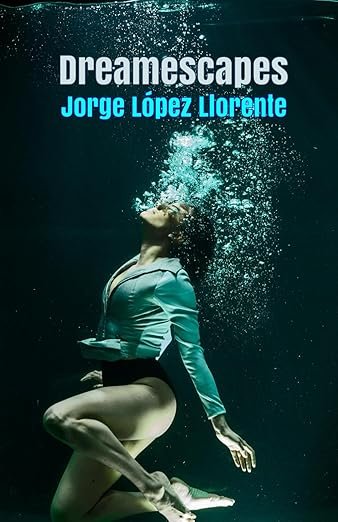
Dreamescapes
Jorge López Llorente
Alien Buddha
For me – and probably for most of us – the first poems I ever read were consumed one at a time. They were standalone units, about one thing, and rightly or wrongly, studying and analysing them at school didn’t do much to counteract this view. Especially when the poem you’re looking at is just one piece on a page of an anthology – and for many, this is how we continue to encounter poems later on.
The joy of a collection of poems is how they speak to, and add meaning for one another. In Dreamescapes, Jorge shows just how the structure and interplay between poems can make the reader think even more deeply, adding extra layers of curiosity through form and detailed pieces that feel meant to sit together.
The pamphlet opens with Inside the Breaking Wave, a beautifully descriptive piece written in the form of the wave from its title. We’re then immediately invited to revisit the same ideas, with Jorge using blackout and erasure from his own lines to reinterpret what we’ve just read - and in doing so, encouraging us to think about each of these waves in different ways.
This idea of the familiar, but slightly distorted, appears in several ways throughout the sequence of poetry. Most of the poems circle around two ongoing motifs – water and dreams – so we’re given a set of familiar images, but each poem takes us somewhere a little less expected.
You can see these twists in the language, too. Jorge interrupts his vivid descriptions with hints of something darker: ‘a fire in his wet eyelashes’ from Inside the Breaking Wave; ‘thick-lined tear pearls / like aspirins dissolving as they drop’ from Drowning Girl. The ‘plastic spiderweb, in a perfectly symmetrical flower-like pattern’ from Dreamcatcher later carries ‘bad energy, or worse, no energy at all’.
The collection centres around the titular poem, Dreamescapes: a crown (the ultimate familiar-but-let’s-go-somewhere-else-now poetic form), and a gorgeous, character-focused narrative that subtly distorts its own structure as it develops, until it, like much of the collection becomes something else entirely.
I won’t ruin the ending for you – you should read this pamphlet for yourself – but as we reach the concluding poem, Crying for Leaving, Jorge’s ability to play form and familiarity off one another reaches a curiously effective twist at the poem’s climax, leaving you with a lot to think about.
Jorge was kind enough to answer some questions about his pamphlet...
What influenced you to start writing poetry?
According to my parents, I said I wanted to be writer ever since I was seven years old, so I guess I always had the impulse to write. At first, probably due to novels' greater mainstream influence, my aspiration was to become a novelist, so when I committed to writing regularly at 15 I focused on short stories, but I was already intrigued by poetry from a young age. I started to combine writing poetry and fiction one or two years later, just before university, inspired by learning about Romantic poetry at school and discovering Rimbaud, Baudelaire and Sylvia Plath on my own, as a moody teenager. I stopped being a moody teenager, but I never stopped writing poetry since then.
How did the idea for this pamphlet come about?
After publishing my first-ever poetry collection (in Spanish), 'Los ojos desdibujados', which focused on selfhood, mostly with first-person voices, I wanted to widen my scope, with more third-person and second-person voices, as well as landscape-based poems, beyond the individual. I immediately thought of the sea, which is a long-time obsession of mine, and of the sea's role as our planet's subconscious, so I instinctively associated it with dreams, one of the book's key themes. I wrote the pamphlet in one go in summer, partly at the beach and mostly during Madrid’s brutal heatwaves, landlocked and pining for the sea, which reinforced all the ocean imagery and made this is a summery but dark book - a bit of summertime sadness, as Lana del Rey would say.
There's a lot of interesting structures and form across the pamphlet. What drew you to these?
Both as a writer and as a reader, I crave variety. I have always been interested in both traditional forms and the avant-garde, which are not mutually exclusive and should suit the mood of each piece, in my opinion. Some of the poets who inspire me the most, like Alice Oswald, Hart Crane or Derek Walcott, excel when they alternate or combine both, expanding what is possible in poetry. Personally, I also wanted to challenge the idea that you need to have one very particular ‘voice’ or ‘style’ as a writer, which is especially limiting for narrative poetry.
Were you thinking about how the poems interact with one another as you wrote, or did that come later?
I was thinking about the mirror-like structure of the whole pamphlet from the start: I wanted the last poem to be the reverse of the first one, the second-to-last one to respond to the second one, and so on, in both form and content. All of the poems were expressly written for the book in the same summer, so it was natural to stick to similar themes.
What’s a line or idea from the collection that you hope readers don’t miss?
The idea of ‘daydreaming of no longer dreaming’, at the end of the poem 'A few weeks into the dreams', still haunts me, years after having written it. In fact, I'm writing a new poem along those lines right now to keep fleshing out this idea. It poses the questions at the heart of the book, for which I have no answers: is it better to fantasise or face reality, and to what extent can we even control that? Regardless, I love it when readers tell me they have a favourite poem or line in the book that I would have never expected, so each to their own!
What do you do when a poem won’t behave?
I always hope the poem misbehaves a little. I don't want a poem to fit perfectly into certain expectations or to deliver a message neatly. Sometimes, I think that what you want a poem to be at first is not what it should be in the end - there's value in letting it flow without knowing where you're headed and killing your darlings. That said, when I feel a draft is falling flat, I try to forget about it for a while, pay attention to other media like fiction or films, churn out some automatic writing without pressure, and then edit the poem with fresh eyes and hopefully new ideas. If all else fails, I usually cannibalise the best parts of it for future poems.
What was the hardest poem to write?
The narrative poem sequence in the middle, 'Dreamescapes', was the hardest part, because this genre was uncharted territory for me, even though I tend to write long poems and poetry with some narrative qualities. It was difficult to keep up the balance between the more abstract lyricism and the specific narrative across so many pages, so I was constantly rewriting it over several months. As it is a crown of sonnets that starts out with tight, traditional metre and becomes increasingly irregular until it dissolves into fully free verse, the poetic form was also fun but more challenging than usual sonnets or just free verse, and it required extra planning.
This is your English language debut - does your process differ, depending on the language you write in?
There are slight differences, which probably affect my style in each. When writing in Spanish, I find myself turning to more raw emotion first, and giving it shape and rhythm later when it cools down, whereas in English I tend to intellectualise my approach to the poem, often thinking carefully about the form before I even get any words down on paper, and then the emotion and the tension seep into the language more gradually. However, sometimes it all gets mixed up in my head, together with my ideas for fiction: reading a Spanish novel may spark an idea for an English poem, for example. Rarely, I will jot down ideas for a poem in Spanish that ends up becoming a poem in English, or vice versa, but I make an effort to focus on writing in one language at a time, even if I'm always inspired by literature in both languages equally.